

What Clean Up Of A Decease Body Cost

To follow Dale Cillian as he works is to witness the goriest details of the human demise. Those scenes — and this story — are not for the overnice.
"The freaking pool's non draining like I had hoped," Dale Cillian laments. "He just broke down so bad."
In that location are bits of decomposed human body clogging the pool pump in an Ahwatukee lawn, left after someone died in the water in the oppressive August estrus and wasn't discovered for days.
At 60 and the owner of Biopro, LLC, Cillian has been in the "biohazard cleanup" industry for nearly half his life, but this is i of the worst cases he's seen. He'll exist able to talk well-nigh it vividly for days later on.
Here'south the affair about cleaning a pool after someone has died in it: Information technology's not as easy as one would recall, Cillian says. Depending on the size of it, yous're going to want perhaps 50 gallons of chlorine to knock down the bacteria levels, non to mention deodorizers and disinfectants to counter the odor. And oh, the odor. "Information technology'due south disgusting," Cillian says. But more on that subsequently.
Something about chlorinated water causes the claret to suspend, like a cloud inside it, rather than mix in. He tin tell by the manner the deject is shaped that the police used a pole, or something, to pull the body closer.
And and then there's the fatty. Nobody thinks near human beings existence fat — but that's all we are! Cillian declares — and boy exercise y'all know it when you lot're trying to disinfect a pool. The man torso melts as it decomposes, and for days the swimming pool'due south gentle waves have lapped thousands of those dime-sized xanthous droplets to and fro, until sun-liquefied human being fatty has coated e-ver-y-thing: the plumbing, the pumps, the filters.
Cillian likes to say you tin judge instantly the amateurs and the professionals by how they respond to cleaning fat.
"They recall they're going to go throw bleach on stuff," Cillian cries out later, indignant, before stating what is obvious, to him. "Information technology's fat. It's oil. Just like whatsoever other oil y'all deal with, you accept to use a degreaser."
Every inch of the pool will have to exist disinfected, scrubbed, steam-cleaned and acrid-done. He'll take to drill out the pool pump and replace every plastic part. It'due south going to be a three-twenty-four hour period task, at to the lowest degree.
At this bespeak, Cillian is exasperated. He heads to his van to retrieve gloves, a mask and a white protective Tyvek accommodate. He has a job to outset.

It was never supposed to be Dale Cillian'south total-time job to clean up later expressionless bodies, after the homicides, suicides, automobile accidents and other morbid tragedies of the world. For one thing, the industry didn't exist when he was growing up in a tiny Ohio town.
In retrospect, the signs in his childhood were there. Equally a teenager, Cillian dated the girl of the town's fire main, who in one case entrusted him with retrieving graphic photos and reports on a local drowning victim. In high schoolhouse, his scientific discipline form took a field trip to the coroner's office; Cillian constitute it more intriguing than spooky.
In 1985, Cillian was fresh out of the fire academy and had started working as a Phoenix firewoman. I summer day, he returned to his apartment complex to a discover Mesa firefighters clustered effectually one of his neighbor'south units. The guy had been dead for days, maybe fifty-fifty a week or two. It's a sight Cillian has never forgotten, both for how gruesome and ridiculous it was.
"Mesa's protocol at the fourth dimension was, no thing what the status of the body, they had to put a monitor on him and cheque him," Cillian says. "I nonetheless remember seeing that guy, and he was really bloated: imperial, black, brown, green." Sure enough, firefighters had placed three small electrode pads upon the bloated trunk, just in instance. Certain enough, he was dead.
After responders removed the neighbor'south trunk, Cillian and his apartment manager chosen around request if anyone specialized in this kind of cleanup. To his surprise, there was no i who did.
"We must have called every freaking funeral abode in the state," he says. "A lot of them said, 'If yous observe somebody, let us know.' "
Cillian volunteered to make clean upwardly the man'due south apartment even though, he realized years afterward, he had no thought what he was doing. His fire grooming meant he was at least familiar with protective gear. Cillian went into the stench-filled unit with a firefighter'southward air pack rated for half an hr. Within xv minutes, he was out of fresh air and had to switch to a regular mask.
The city of Mesa donated a dumpster but accidentally left it without a drain plug; anything moisture they tossed into information technology seeped like molasses out the bottom. And so in that location was the matter of that terrible odor, which sickened for days afterward the maintenance man who was profitable him. It clung to the flat, and Cillian was at his wit's terminate on how to banish it. At last, he chosen some other company and discovered how they used an ozone machine to deodorize a site.
"That's how I learned to do information technology," Cillian says. He took note, then followed up with the same funeral homes he had called earlier. He had in fact found someone to practise the job, he told them: Himself.
That year, he formed his ain company, Specialized Services Inc. It would go through a scattering of proper name changes to go Biopro. Cillian gathered cleanup jobs on the side through referrals from funeral homes and police officers. He tried to put an advertizing in the Yellow Pages, but was told there was no appropriate category for what he did. He was the first company of his kind in the Phoenix area.
"They just wouldn't do it," he says. "I guess it was a big deal to put a new list in."
Information technology would take years earlier he could become listed in the Yellow Pages, and the thrill of that small victory has not escaped him. He had never been then excited about a phone book coming out.
Those were the days.

It didn't take long for Cillian to become the get-to man for crime scene cleanups in the Valley. He continued working total time as a Phoenix firefighter, putting in 24-60 minutes shifts, then taking odd criminal offense-scene cleaning jobs during his 48 hours off.
Five years subsequently, a man climbed into a dumpster in Glendale, looking for cans. What he found instead was a blood-soaked carpeting that had been "black-bagged" and tossed in with the regular garbage; he reported it to police, who recognized the carpet as the aforementioned one from a recent offense scene. That was how, in the midst of the country'southward AIDS scare, the urban center of Glendale became the first in the region to specially outsource its biohazard cleanups. Cillian got the contract.
Cillian's business was rapidly expanding. He hired a role-fourth dimension assistant, then a full-time employee. He sought out others across the state who were in the same grisly line of piece of work. He willingly gave interviews, posing for photos in his Tyvek suit and gas mask.
He obtained a contractor'south license and became certified in a dozen specialties: Blood-borne pathogen work. Hazardous waste operations. How to handle asbestos, lead, anthrax.
Cillian also became fluent in the special lingo that comes with biohazard cleanup. "Decon" was short for decontaminate, the verb, non to be confused with a "decomp," referring to a job in which there was a decomposing torso. If a task was "black purse merely," then at that place was no medical or biohazardous waste involved. If you had to "reddish bag" a site, information technology ways there was medical waste matter.

But more of import, Cillian learned things that tin can only be known later years of experience. That brain affair was a lot more delicate — and a pain to clean up from cobblestone — than he imagined. That it's improve to wear sneakers to a cleanup because homo-made materials can be easily disinfected; leather shoes cannot. That if someone dies by a load-bearing wall that tin't be cut out, he tin neutralize the blood. But if the body is decomposed, well, that'southward another story.
"There'south no chemical that'll clean it," he says. "I gotta cut it out. It'due south not going to get away."
Some of the rules were befuddling. The Arizona Section of Environmental Quality has lengthy parameters for what qualifies as "biohazardous medical waste." Trash generated from a lab, doctor's role or hospital e'er has to exist red-bagged, even if it's a pile of gauze pads collected over six months that have no blood on them.
Outside of those clinical settings, the key phrase is "gratuitous-flowing blood." If blood is flowing, it must go into a red handbag. If blood has dried or coagulated, it's non medical waste.
"If I accept a big pool of claret, I could use kitty litter — which works really good — and then I could black-pocketbook information technology because it'south not flowing anymore," Cillian says.
And so in that location's the matter of transporting that waste matter to 1 of the three authorized medical-waste disposal facilities in the Valley. Just to apply for a medical-waste transportation permit with ADEQ costs $2,000, and then $750 to renew it each year. Any vehicle used to transport medical waste must have an extra license from Maricopa County, which results in higher insurance premiums, also. Cillian has paid for it all.
"You'd better accept the permit because you're a sorry excuse for a biohazard company if you can't fifty-fifty transport your own waste product," he says.

Cillian apologizes for the mess upon inbound Biopro headquarters, located in a nondescript part park in Gilbert. It'due south in a land of disarray because he'due south been half-heartedly packing, preparing to downsize and move. He simply doesn't know where to or when.
On the floor are piles of papers, old framed newspaper articles and awards, each detailing a dissimilar achievement. There is a younger Dale Cillian, grin through a gas mask for the camera as he talks about Biopro's foray into meth lab cleanup. There he is, in several clippings nearly his volunteer cleanup work in New Orleans after Hurricane Katrina struck. There is his plaque from the American Bio Recovery Association: "Dale Cillian, President / 2006 - 2010"
Attached to the office is a 3,000-square-human foot warehouse, and when Cillian flicks on the lights, something like a miniature abandoned Home Depot appears. From floor to ceiling are shelves filled with supplies: red medical waste bags, black trash bags, canisters of chemicals, HEPA filters, rug machines, hand sanitizers, aerosol sprays, row of metal fans, ladders of every length, dehumidifiers. In the very back are a cluster of brand-new vacuum cleaners; often he uses a vacuum simply once.
"It's cheaper and faster to dump it than to spend the fourth dimension cleaning it," Cillian says.
Some of these supplies he hasn't touched in years. Balanced on a pile of tools is an anthrax detection kit. In a small enclave are a washer and dryer he uses just for wearable he wears to scenes.
At a nearby lot, he has parked a small-scale fleet of Biopro-branded vehicles: a 16-foot van, an 18-foot van, 2 Ford F-550 trucks. It pales in comparing to what he used to take: a light trailer that could illuminate a stretch of highway, two additional trucks. He has kept a flatbed truck with its own water hoses, pumps and traffic cones.
The conference room seems frozen in the mid-'90s. On the bookshelves are countless training videos in VHS format, books and binders with titles like "Fun With Chemistry" and "Restorative Drying." Bankers boxes concord rows of photographs from almost every job he'due south cleaned, each envelope containing 4" x 6" prints — doubles. Cillian stopped counting how many jobs he and his company had handled when he reached 25,000 a few years agone.
"Scenes never wait unlike," he says. "Just the structures."
Nevertheless, he fishes out a photo from ane of the few scenes that has stood out from the hundreds of others: a homicide, in which a trail of blood led to a bloody handprint on the phone.
He has never been able to forget information technology.

In that location are withal times the chore trips him up.
Upon initial inspection, the firm didn't seem like information technology was in likewise bad of shape. The human being had died away from the walls, on the starting time floor. Cillian pulled up role of the carpet and gave the concrete a cursory scan. Nothing that couldn't be acid-washed, he thought. He noted one or two flies, at most, and quoted the homeowner $3,000 for the job.
What he hadn't seen were the cracks in the physical. Underfoot, decomposed trunk fluids were seeping through the fissures, insignificant to the average homeowner, only a bona fide disaster for biohazard cleanup.
"It really went into the concrete and it actually spread in those cracks," Cillian says.
That the human had died on the home'due south outset flooring now was a detriment; if he had passed away upstairs, at least Cillian could have pulled out the floor and replaced it. The ensuing job would require him to jackhammer a huge section of the concrete, lest the fluids keep through the cracks and contaminate the walls.
When he started the chore, Cillian pulled up the rest of the carpet. By then, there were "tens of thousands" of maggots underneath.
"Information technology was a friggin' nightmare," Cillian remembers. "(The price) should take been double."
No longer could he simply acrid-wash the surface of the concrete. He would need to degrease it, too, after blasting equally much of the slab away as possible.
"Cleaning it and getting rid of all the contagion are two different things," Cillian says. "One time you decompose, information technology's a whole dissimilar ballgame. It'south one thing to be fresh, merely it's a hurting when information technology starts the other way."
Cillian is well-nigh obsessively meticulous in his cleanup jobs, in part because it's required, just likewise because it's "simply Dale," says his married woman. Rhonda Cillian has watched her hubby throw everything into growing Biopro.
"He's a Type-A personality," Rhonda says. "He wants to exist good at what he does. For years and years, he was the authority."
They met about 25 years ago at Studebakers, then a popular Valley hangout for Phoenix firefighters. Even then, Dale had a cell phone, a clunky, brick-like Motorola. "What the heck is that and why would you need one?" Rhonda remembers request. Dale carried a pager, too.
After a few dates, he told her he cleaned up offense scenes on the side. She wasn't fazed — fifty-fifty when Dale got a phone call in the middle of a date and she had to tag forth with him to a job, a grisly murder at an Asian market in central Phoenix.

After they married in 1992, Rhonda continued being involved in the business concern. She would accompany him to sites sometimes, consoling families. They used to choice people up from Sky Harbor airport, relatives of the deceased who would arrive in a foreign metropolis confused and grief-stricken. When their son was built-in, she stopped going to criminal offence scenes. Now she handles the business side of Biopro.
On a contempo forenoon, the Cillians' sprawling, immaculate abode smells of freshly baked assistant breadstuff. The bananas had been spoiling, explains Rhonda, and she didn't want them to become to waste matter. Unlike at Dale's warehouse, here there is no sign anyone in the household is involved in biohazard cleanup.
"There's two rules: I don't desire to talk about it at dinner," she says. "And I don't want to talk about information technology in forepart of our son."
Other than that, she's grown used to hearing Dale's so-pager, at present cell phone, buzz in the middle of the night on his side of the bed. They're certainly non the typical eight-to-5 family, she confesses, merely it hardly matters. "After yous accept a child, you never sleep the style y'all sleep."
Dale retired from the Phoenix Fire Department seven years ago, and at present Biopro is his full-fourth dimension baby. His cooler is always prepare to become. His apparel are always laid out. He keeps his shoes in one department of the garage.
Yet, Rhonda is keenly aware that increasing contest has put a clasp on Biopro'due south approach. While Dale'due south warehouse and fleet of vehicles sit waiting for the side by side chore, stuffed with every imaginable tool that could be used for any possible scenario, other companies operate with lower overhead: out of a van, for example. Or they are national companies who outsource to several unlike Arizona contractors, oftentimes the lowest applicant.
"You lot can't compete with someone who's going to come in at $35 an hour," Rhonda says. "I expect at it this style. If you lot needed your teeth cleaned, would you become to a gynecologist? They're both doctors. But this is what we specialize in. We do biohazard cleaning and it's different."
Is it possible for a mom-and-pop criminal offence scene cleanup shop to have a time to come in this business organisation?
"I retrieve there is," she says, "but information technology's just getting to exist a smaller piece of the pie."

In August, in a small conference room in Tempe, representatives from iv of the Valley's biohazard cleanup companies sat awkwardly around a table with city staff members. They were there to ask questions before behest on Tempe's biohazard cleanup contract, which Cillian has held for years.
There is Frances Vierkoetter, owner of Clean Scene AZ, who spent 12 years auditing chemic disposal sites and making sure chemicals were disposed of safely, before transitioning to biohazard. To her, it was all the same.
"It was non a difficult transition. You just bargain with different hazards," she says later. "They all have requirements. They all need permits."
Her compact south Phoenix office is full of fastidiously tabbed binders, with foam-colored walls, faux mahogany office furniture and a framed motivational print ("GOALS") that shows an eagle flying into a sunrise.
Almost of her business comes from disinfecting medical boards, similar to stretchers, used in ambulances and hospitals. Behind her role, two employees run piles of orange plastic backboards through a commercial dishwasher-like machine. She has and Cillian have an uneasy human relationship, just she dismisses whatever notion that what she does is not biohazard cleanup.
"In Dale's mind, no 1 knows what they're doing except him," she says. "I simply stay out of it because I don't have fourth dimension for that."
At that place was also Sharan Godwin, owner of Criminal offence Clean Decontamination, LLC, who has run her business concern out of her abode and van for more twenty years. Like Vierkoetter, she has a distant human relationship with her peers in the manufacture. Like Vierkoetter, she has clashed with Cillian in the past.
"I accept no contact with my competitors," Godwin says later. "I accept no intention of getting into their bug. I but kind of practice my own thing."
These days, few cities' biohazard contracts include cleanup of individual homes, which now falls to insurance companies to cover. Instead, about one-half of municipal calls are for cleaning up roads after traffic accidents and hitting-and-runs. The other half is unremarkably cleaning up police cars and jail holding cells subsequently people have vomited or defecated in them, often for fun. It would exist fair to call information technology the least glamorous side of biohazard cleanup. Only fifty-fifty those contracts at present are difficult to snag.
In the '90s, Cillian had just a scattering of competitors. By now, past his estimates, in that location are hundreds. Restoration companies, carpet-cleaning companies, janitorial services, hazardous material companies — all have gotten into the biohazard cleanup business organisation in some way or another over the last iii decades.
"There'due south a lot of people who call back they're going to get rich on this quick," says Andrew Yurchuck, president of the American Bio Recovery Association and owner of a biohazard cleanup company in New Bailiwick of jersey. "That's far from true. They recall it's glamorous. Everybody's seen CSI, OK. It's really terrible work. It's dangerous."
At that place's the postal service-traumatic stress disorder, which he says is no unlike from what soldiers, police officers and emergency medical service personnel get. One time Cillian accidentally was stuck with a needle that had been placed in a carmine bag without a cover. Every quarter, he gets checked for AIDS, hepatitis, syphilis, everything.
"This is an explosive growth industry and quite honestly near of the rest of the contractors out there actually aren't qualified to do this type of cleanup," Yurchuck says. "In that location's not a whole lot of oversight.... Y'all would be amazed at how many companies are not registered in u.s.a. they operate in."
Cillian charged $175 an hour when he started 29 years ago, "which I thought was fair." He's raised his prices $25 to $50 an hour since then, depending on the contract. Only gas prices have doubled. His insurance prices have tripled.
"It'southward non fifty-fifty shut," he says. "Everything's gone upwardly so I'1000 barely making $x to $15 an 60 minutes per job... It's not like you exercise this five times a week, every calendar week."
Twice a week, he travels around the Valley and picks up medical waste from several companies. ("Home-generated medical sharps," such every bit needles used by people with diabetes, are exempt from this.) If he didn't get these odd jobs, he'd be out of business, he says.
Several weeks afterwards, Cillian calls, absolutely abreast himself about the Tempe contract. The metropolis awarded it to Godwin, whose bid was the lowest at $threescore per task. He had bid lower than his usual rate: $160 per 60 minutes.
"Would you lot get up at 3 o'clock in the morning to do this? For $lx?" he says, irate. "You couldn't get Molly Maid to go out and practice anything for $60. You really think this can exist done?"
He's on a roll. He rattles off names of friends in the business in Australia, South Africa, Brazil.
"They're not like this anywhere in the United States. We're the laughingstock of the state. We're the laughingstock of the world! And we are!" he says. "We're a joke for what nosotros charge here. It's only Phoenix."

Cillian has a lot on his mind the week he goes to clean the mobile home, a depression-slung stilted structure in a quiet subdivision on the border of Mesa and Scottsdale.
One of his Ford F-550 truck needs new tires, which is going to set him back several hundred dollars. His sole employee quit several weeks agone, and since then Cillian has been fielding all calls and jobs on his own. He is wearied. His back aches. "You just ho-hum downwardly as you become older," he says.
He's still trying to hire somebody, something he's grown used to in an industry with a predictably loftier turnover rate. Only the responses he's received to his Craigslist ad have been less than promising, even after he moved his post from under the 'Skilled Trade/Craft' category to 'General Labor.'
"In that location was ane guy who wanted $100 an hour," he says, balking. Those are the people who accept watched i as well many episodes of CSI, who think this is a get-rich-quick industry.
Information technology'southward the flies that snap Cillian out of his thoughts and back to the nowadays. When he steps into the trailer, he sets off a tornado of flies — hundreds, if not thousands, of them have blanketed the walls, almost blending in with the simulated wood paneling in the sleeping accommodation and the yellow wallpaper in the bath. Cillian unleashes a torrent of profanity.
He doesn't know which is worse in this case, the flies or the pervasive scent of a rotting corpse. How would he describe the odor? Iii decades later, he can't quite find the right words for how horrible it is. "It'south sweet," he says subsequently a long break. "And repulsive." If you can't conjure up how it smells, then you've never smelled it before. And if you've e'er smelled it before, then you have never forgotten.
The mobile home's owner had told Cillian information technology would price $6,500 to demolish the trailer. He told her information technology could be salvaged for less.
Cillian brings his boxy metal ozone car into the living room. He has got to do something about this odor. He places the automobile on an already-open ironing board, side by side to a half-well-baked shirt still draped over the board's edge. Information technology begins buzzing, sounding similar an budgeted swarm of wasps.
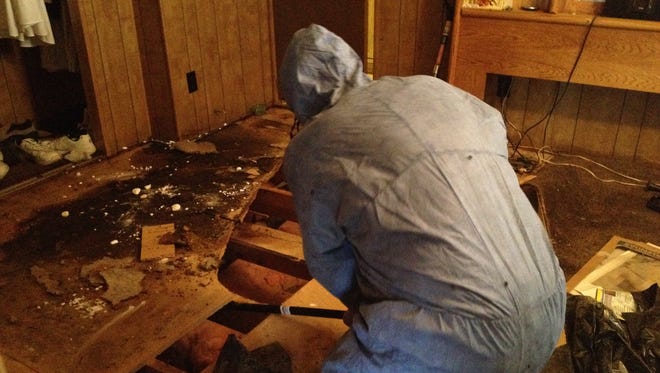
He hauls the mattress out outset, then the bedframe, the piles of laundry that had been side by side to the expressionless body. He rips upwardly the carpet, the underpad, each layer revealing what is still a startling big amount of decomposing body fluid that has seeped through. Finally, he is downwards to the floor boards, ready to saw out the portions stained past decomposing body fluids. He's the one-man star of his own, macabre home-makeover show.
Within the adjust, Cillian is marinating in his own sweat, exacerbating the stale heat inside the trailer home. The mask weighs on his confront, and he pauses every 10 minutes to take a break. Each fourth dimension, he yanks a paper towel off a roll to swipe at his face up.
"I tin can only go so long in this," he says with a deep sigh. "I've gotta stop. I'chiliad dying."
Later on several hours, a neighbor emerges from her neatly kept screened-in porch next door and casts Dale a sympathetic await.
"I'one thousand sorry you accept to be out in this. You need water?" she asks, earlier shaking her caput and talking about how foul the stench had been for a week. "Beloved, they're not going to be able to get this stink out."
Cillian seems to perk up at this proffer. He assures her that he, if everyone, can.
"I created this whole thing," Cillian says shortly afterwards, at the suggestion that he retire. Retire? From the industry he practically invented? he asks. He shakes his caput. He's besides invested. He is never going to retire, he insists.
He dons his mask over again and creaks back up the wooden steps into the fly-filled room. He has a job to finish.

Source: https://www.azcentral.com/story/life/az-narratives/2014/11/24/last-cleanup-7-things-to-know-about-decontamination-biohazard-biopro/70062092/
Posted by: bradleyroutionce.blogspot.com
0 Response to "What Clean Up Of A Decease Body Cost"
Post a Comment